In the industrial sanding sector, many buyers first ask about grit size. Is P80 sufficient for material removal? Should P320 be used before painting? Is P600 suitable for primer sanding?
While these questions are certainly important, grit size is only one aspect of abrasive performance. The backing material also determines how effectively the abrasive product performs on the surface.
At Aozhong, we collaborate with distributors, machine shops, OEM buyers, and industrial users to provide sandpaper, sanding discs, sanding rolls, sponge abrasives, mesh abrasives, and non-woven abrasives. In many procurement projects, the issue is not merely about selecting the right grit size. A more valuable question is:
| Evaluation Question | Selection Reference | Recommended Abrasive Products |
|---|---|---|
|
01 Is the surface flat or curved?
|
Flat surfaces can use sandpaper, film or sanding cloth. Curved surfaces may require foam or non-woven abrasive materials. |
Sandpaper Film Sanding Cloth Foam Non-woven
|
|
02 Is sanding done manually or mechanically?
|
Manual sanding may require foam, sanding sheets or non-woven pads. Mechanical sanding may require sanding discs, hook-and-loop discs, PSA discs, mesh discs or film discs. |
Foam Sanding Sheets Non-woven Pads Sanding Discs Hook-and-Loop PSA Discs Mesh Discs Film Discs
|
|
03 Is the process dry or wet sanding?
|
For dry sanding, choose sandpaper, film, sanding cloth or sanding mesh. For wet sanding, use wet/dry sandpaper or suitable film products. |
Sandpaper Film Sanding Cloth Sanding Mesh Wet/Dry Sandpaper
|
|
04 Is dust removal required?
|
If dust control is critical, sanding mesh or porous sanding discs may be required. |
Sanding Mesh Porous Sanding Discs Dust Extraction Products
|
|
05 What is the workpiece material?
|
Primers and fillers may suit mesh abrasives. Metal may require cloth or non-woven products. Automotive surface preparation may require film abrasives. |
Mesh Abrasives Cloth Abrasives Non-woven Film Abrasives Sandpaper
|
|
06 Is the operation coarse or fine sanding?
|
Coarse sanding may require sandpaper or cloth abrasives. Fine sanding may require film, foam or wet/dry sandpaper. Surface pretreatment may require non-woven abrasives. |
Sandpaper Cloth Abrasives Film Foam Wet/Dry Sandpaper Non-woven
|
Which backing material is suitable for the current sanding process?
Paper backings perform differently than cloth backings. Film backings work differently than foam backings. Mesh sanding discs are not the same as perforated paper sanding discs. Non-woven sanding pads are not simply a soft version of sandpaper.
Each backing material has its unique advantages, as well as limitations. Choosing the wrong abrasive backing material can lead to tearing, clogging, poor surface contact, reduced product life, uneven sanding marks, or increased rework costs.
This article will explain the selection logic for paper, cloth, film, foam, mesh, and non-woven backings in industrial sanding applications.
| Backing Type | Main Use | Advantage | Limitation | Common Products |
|---|---|---|---|---|
|
01 Paper Backing
|
General sanding, wood, paint and primer | Cost control and format flexibility | Lower tear resistance |
Sandpaper Sheets Sanding Discs Sanding Rolls
|
|
02 Cloth Backing
|
Metal, edges, belts and sanding rolls | Tear resistance and pressure resistance | Higher cost and less suited for fine flat finishing |
Abrasive Belts Cloth Rolls Sanding Strips
|
|
03 Film Backing
|
Automotive, fine sanding and finish preparation | Scratch consistency and tear resistance | Higher cost than paper |
Film Sanding Discs Film Sandpaper
|
|
04 Foam Backing
|
Curves, contours and hand sanding | Pressure distribution and surface conformity | Not suitable for heavy removal |
Sanding Sponges Foam Sanding Blocks
|
|
05 Mesh Backing
|
Dust extraction, primer, drywall and softwood | Anti-clogging and dust removal | Less support than paper or film |
Mesh Sanding Discs Mesh Sandpaper Rolls
|
|
06 Non-Woven Backing
|
Scuffing, blending, cleaning and conditioning | Conformability and surface conditioning | Not suitable for aggressive leveling |
Non-Woven Pads Non-Woven Rolls Non-Woven Discs
|
The backing material of sandpaper serves as the foundation that supports the abrasive grains. It affects the abrasive product’s flexibility, tear resistance, cutting ability, wear resistance, dust accumulation, and how it contacts the workpiece.
Two sanding discs may use the same grit size and the same abrasive grains, but if one uses a paper backing and the other uses a film backing, the sanding results may differ. The backing material affects:
The choice of backing material not only affects sanding quality but also impacts inventory planning. Distributors supplying auto repair shops may need film sanding discs, hook-and-loop sanding sheets, foam abrasives, and wet/dry sandpaper. Furniture manufacturers may require paper sanding rolls, sanding sheets, and foam sanding blocks. Metalworking customers may require cloth and non-woven abrasive products.
Therefore, before selecting sanding discs or sheets, buyers should ask:
What is the material? What is the sanding stage? Is the surface flat or curved? Is the process dry or wet sanding? Is the user sanding by hand or using machinery? Is dust removal required?
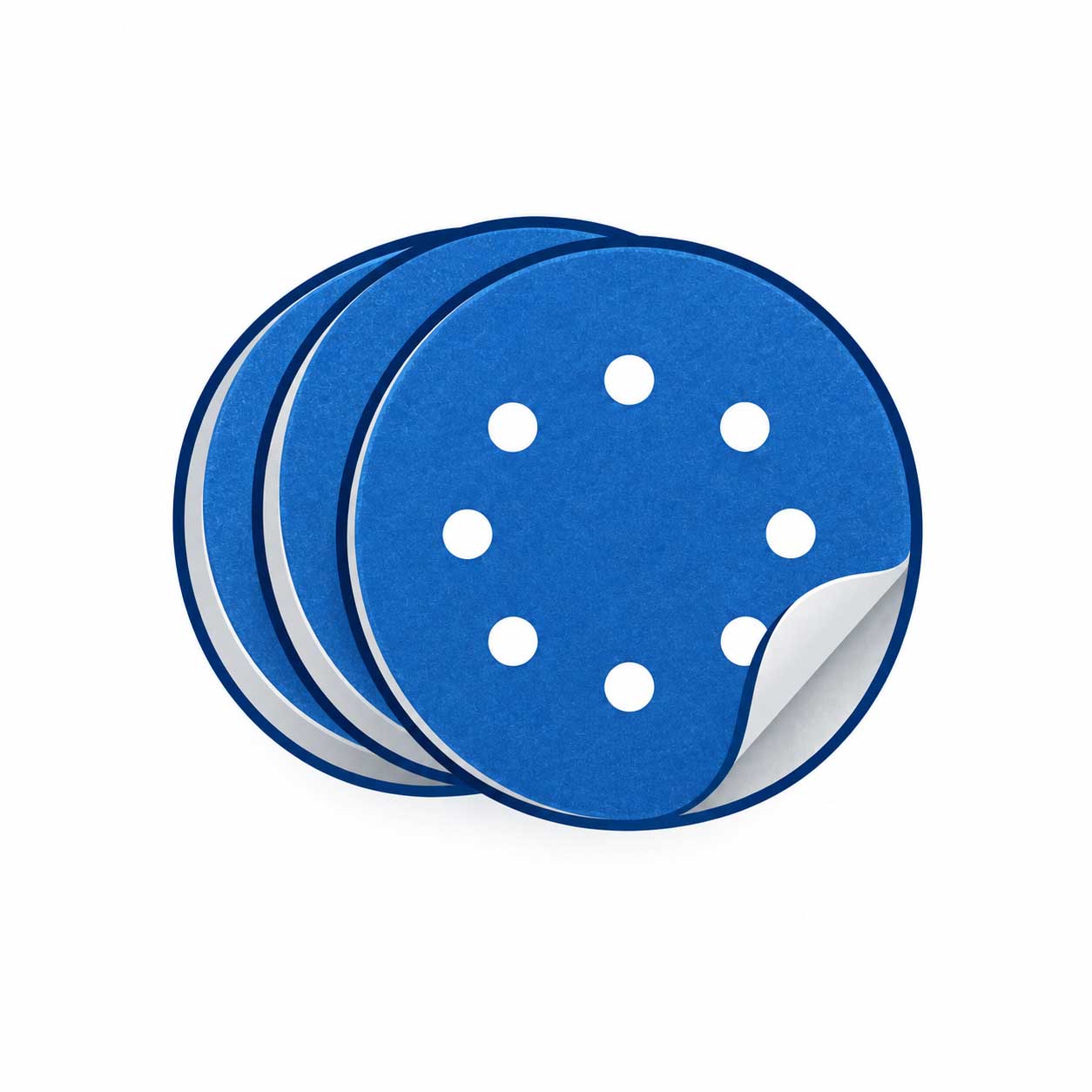
Paper backing is one of the most commonly used substrates for coated abrasives. It is widely used in sanding sheets, sanding discs, sanding rolls, hook-and-loop sandpaper, and self-adhesive sandpaper.
Paper-backed sandpaper is commonly used in woodworking, automotive repair, pre-painting preparation, primer sanding, furniture sanding, drywall sanding, and general surface finishing.
Paper backing is the ideal choice when users need sanding products that balance cost control with specification flexibility. It can be processed into sheets, discs, strips, rolls, and custom sizes, and supports various attachment systems such as hook-and-loop and pressure-sensitive adhesive (PSA).
Paper-backed sandpaper performs exceptionally well in dry sanding applications. In woodworking and furniture manufacturing, paper-backed sandpaper is commonly used in every stage from coarse sanding to pre-painting preparation. In the automotive repair sector, paper-backed sanding discs can be used for filler sanding, primer sanding, and general refinishing tasks.
Paper-backed sandpaper has lower tear resistance than cloth-backed or film-backed sandpaper. Tearing or wrinkling may occur when working on sharp edges, welds, hard corners, or during high-pressure sanding. Unless specifically designed for wet and dry use, paper-backed sandpaper also has limitations in wet sanding.
For heavy-duty grinding, high-pressure industrial sanding, or applications requiring repeated bending of the abrasive, paper-backed sandpaper may not be the best choice.
Paper-backed sandpaper should be chosen for applications requiring cost control, dry sanding, routine surface preparation, and standard sanding.
Cloth-backed sandpaper should be chosen for applications requiring strength, flexibility, resistance to edge wear, and a longer service life under high-pressure conditions.
For example, paper-backed sandpaper is suitable for sanding wood panels, while cloth-backed sandpaper is better suited for metal parts, curved hardware, belt sander applications, and edge sanding.
Cloth backing is widely used in sanding belts, grinding wheels, flap discs, metalworking abrasives, and certain industrial sanding products. It is also selected when the sanding process requires materials with flexibility, strength, and tear resistance.
Cloth backing offers superior tear resistance compared to paper backing. It withstands pressure and movement better. It performs exceptionally well when sanding metals, stainless steel, aluminum, welded parts, curved surfaces, and industrial components.
Cloth backing also performs exceptionally well in sanding rollers because the material is flexible and less prone to rapid breakage. For users cutting sanding belts from rolls, cloth backing withstands repeated folding and manual handling better than paper backing.
In metalworking, cloth-backed sandpaper is often preferred because workpieces may have edges, burrs, welds, and surface defects. Under these conditions, paper-backed sandpaper may tear, while cloth-backed sandpaper maintains stability for a longer period.
Cloth-backed sandpaper is typically more expensive than paper-backed sandpaper. It may not be suitable when users require a very flat and uniform surface finish in fine sanding applications. For certain automotive surface finishing or paint preparation tasks, film-backed abrasives may provide more consistent surface contact.
For certain flat finishing processes, cloth-backed abrasives may be too stiff or too flexible. If the process requires control over scratch depth and surface uniformity, buyers should compare cloth-backed options with film-backed or paper-backed alternatives.
If strength and durability are your priorities, choose cloth-back.
If surface uniformity and consistency in fine sanding are your priorities, choose film-back.
In the metalworking sector, cloth-back is typically the better choice. However, for automotive primer sanding or topcoat preparation, film-back may be more suitable.
Film backing is widely used in sanding discs, film sandpaper, automotive abrasives, fine finishing products, and precision sanding applications. It is commonly found in automotive refinishing, paint surface preparation, primer sanding, and fine finishing processes that require surface uniformity.
Film backing provides a stable substrate for abrasive particles. Compared to paper backing, it offers better tear resistance and more uniform thickness. This helps create a more consistent scratch pattern.
In automotive sanding, scratch consistency is critical. If a sanding pad produces uneven scratches, defects may become visible after priming, topcoating, clearcoating, or polishing. Film backing helps mitigate this risk because its substrate surface is more uniform.
Film sanding discs are also compatible with hook-and-loop systems, porous sanding discs, and dust extraction systems. During fine sanding stages, film backing effectively supports pre-paint surface preparation.
Film backing is typically more expensive than paper backing. For coarse sanding, extensive material removal, or applications where surface consistency is not a primary concern, a film backing may not be necessary.
Additionally, film backing may not be suitable for applications requiring repeated manual folding. In such cases, paper, cloth, foam, or non-woven backings may be easier to handle.
For general sanding and cost control, choose paper backing.
For fine sanding, automotive refinishing, surface consistency, or scratch pattern control, choose film backing.
Buyers serving auto repair shops may need both. Paper discs can be used for general prep work, while film discs are suitable for primer sanding, paint prep, and processes requiring a high level of paint finish.
Foam backing is widely used in sponge abrasives, sanding blocks, foam sanding discs, soft sanding pads, and manual sanding products. It is commonly found in automotive repair, woodworking, furniture sanding, plastic surface finishing, 3C electronics, and contour sanding.
Foam backing helps distribute pressure. It allows the abrasive to conform to curved surfaces, contours, edges, corners, and irregular shapes. This makes foam abrasives ideal for handheld and fine sanding.
If users sand curved surfaces directly with standard sandpaper, pressure may concentrate in a specific area. Foam backing alleviates this issue by allowing the abrasive to conform to the surface’s shape.
Foam sanding blocks are also easy to grip. They can be used on wood edges, furniture components, automotive panels, plastic housings, primed surfaces, and repair areas.
Foam backing is not suitable for heavy material removal. On flat, hard surfaces, it cannot provide the same cutting pressure as paper or cloth sandpaper. When used on rough metal, sharp edges, or severe burrs, the foam may wear out quickly.
Foam backing also alters the feel of the sanding process. For applications requiring extremely high flatness, the soft foam backing may conform to surface irregularities rather than leveling out raised areas. In such cases, a stiffer backing or sanding block may be necessary.
Choose foam backing for curved surfaces, contours, hand sanding, and pressure control.
For flat surfaces, standard sanding, or rapid material removal, choose paper backing.
In automotive refinishing, foam abrasives are suitable for curved surfaces and edges, while paper or film sanding discs are ideal for flat surfaces and primer application.
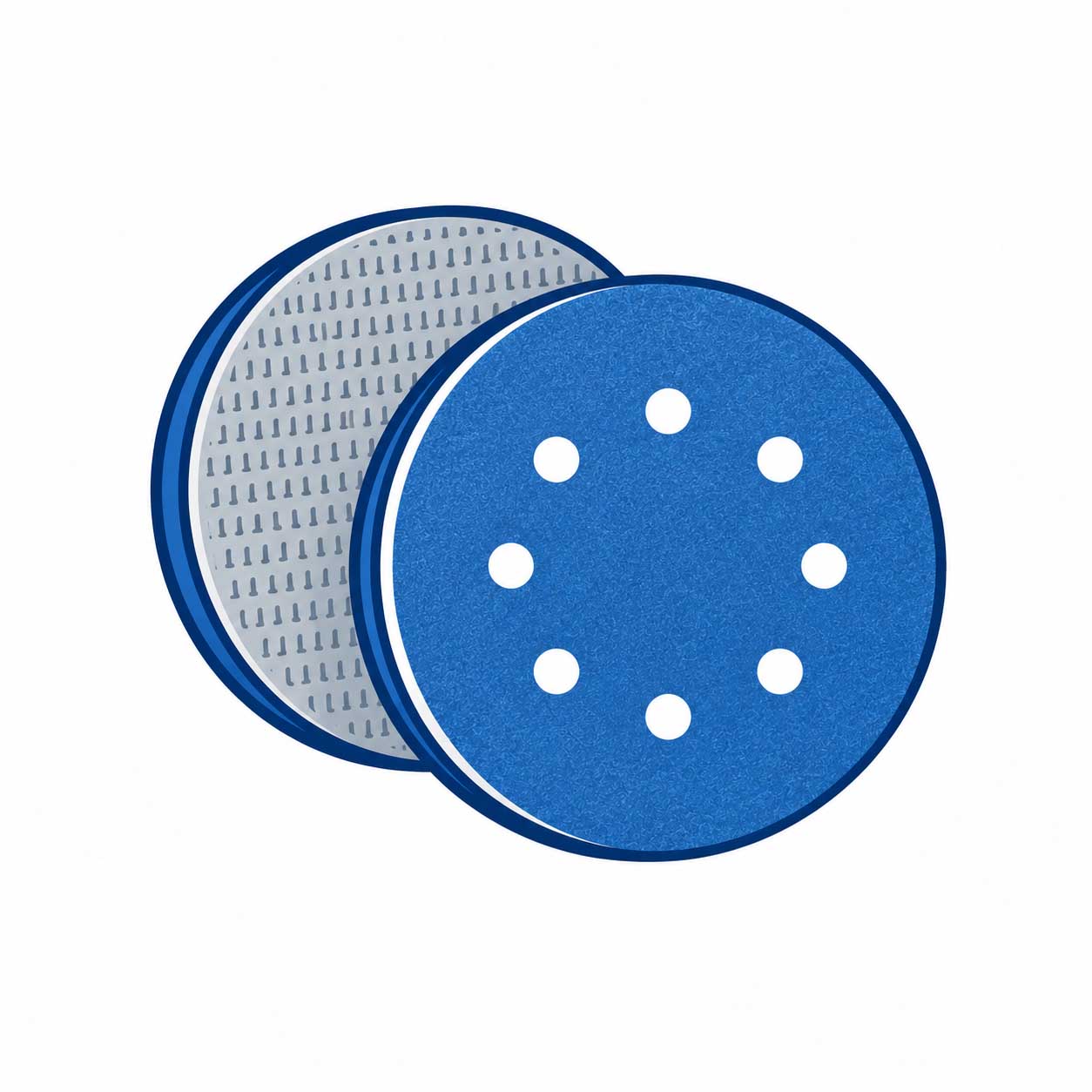
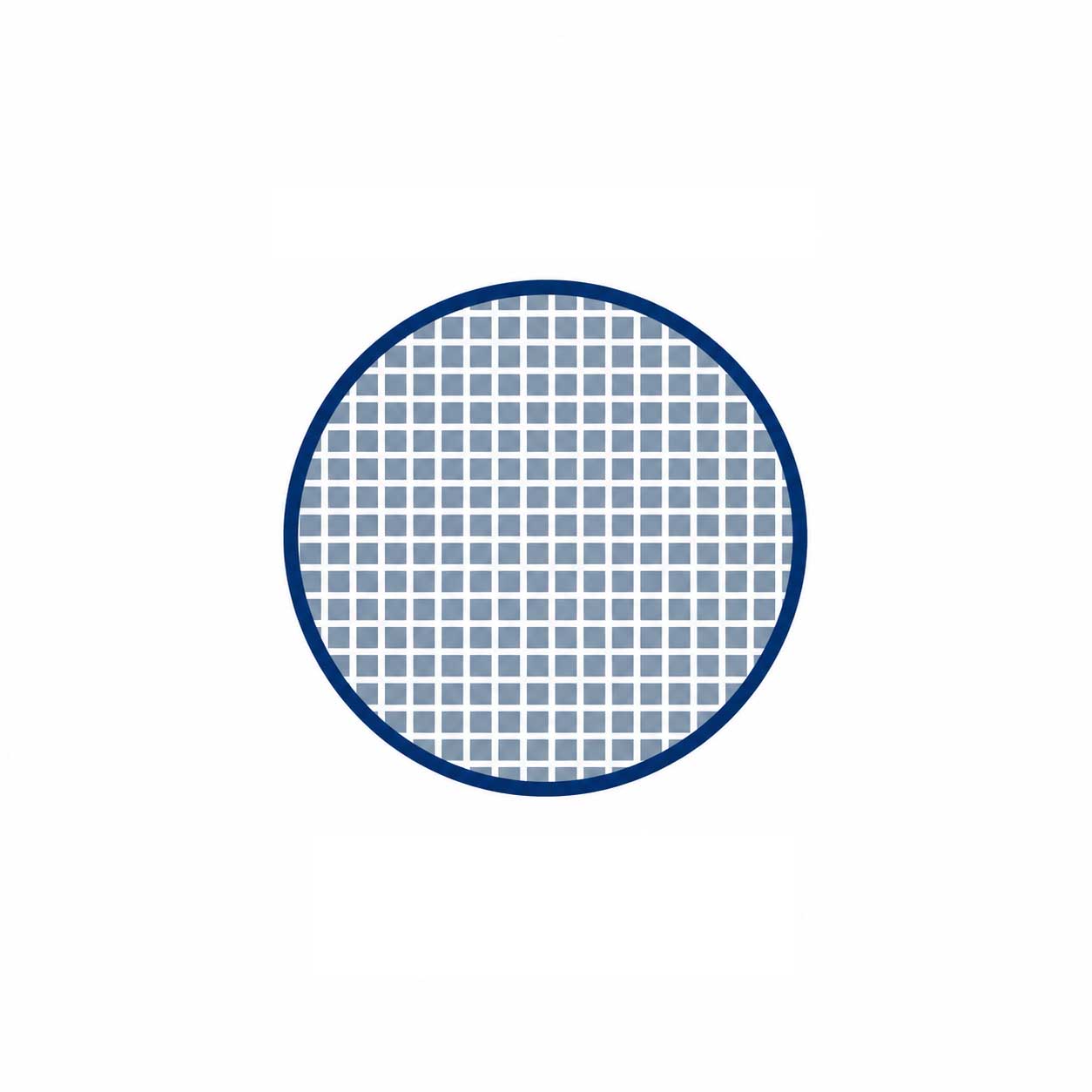
Mesh backing is used in mesh sandpaper, mesh sanding discs, mesh sanding rolls, and dust extraction sanding products. Unlike standard sandpaper with fixed holes, mesh abrasive has an open structure across the surface.
Mesh backing allows dust to pass through the abrasive surface. This helps reduce clogging during sanding. It is useful for materials that create dust or loading, such as primer, filler, drywall, softwood, paint, and coatings.
In workshops using dust extraction systems, mesh sanding discs can improve sanding cleanliness because they do not depend on a small number of hole positions. The open structure can match many pad designs.
Mesh abrasives can also increase product life when loading is the main problem. If dust stays between the abrasive grain and the workpiece, cutting efficiency drops. Mesh helps remove that dust from the contact area.
Mesh backing may not provide the same surface support as paper or film backing in some fine sanding applications. If the user needs a very specific scratch pattern, paper or film may still be preferred.
Mesh can also be affected by tearing if used on sharp edges or aggressive applications. It is best used where dust extraction and anti-clogging are the main needs.
Choose mesh backing when dust extraction, anti-clogging, and pad compatibility are priorities.
Choose paper backing with holes when the user has a fixed pad system and needs standard sanding disc performance.
For automotive primer sanding, drywall sanding, and wood sanding, mesh abrasives can reduce loading. For certain finishing stages, film or paper may still be selected for scratch control.
Non-woven abrasive products differ from coated sandpaper. They are made from nylon fibers or similar mesh structures combined with abrasive grains and a binder. Applications include abrasive pads, non-woven rolls, surface finishing discs, hand-held sanding pads, flap wheels, and related products.
Non-woven abrasives are suitable for cleaning, sanding, finishing, deburring, rust removal, oxide layer removal, and surface preparation. They conform closely to the workpiece surface, reducing the risk of over-cutting.
In the metalworking sector, non-woven abrasive pads are commonly used for stainless steel finishing, weld seam dressing, surface treatment, and cleaning. In woodworking and paint preparation, they can be used for sanding between coats or for surface preparation prior to painting.
Non-woven products truly shine when the goal of processing is not merely material removal but also surface finishing.
Non-woven abrasives do not have the same material removal capacity as coated sandpaper. They are not the first choice for heavy-duty sanding, leveling, or rapid material removal.
Additionally, their grit systems do not always align with those of standard sandpaper. Buyers should understand the grade, density, abrasive particles, and intended applications, rather than comparing products solely based on grit numbers.
Choose cloth-backed abrasives when pressure needs to be applied for cutting, grinding, and sanding.
Choose non-woven-backed abrasives for transition work, rough grinding, cleaning, and surface finishing.
For example, cloth-backed abrasives can be used to remove weld marks, while non-woven-backed abrasives can be used for surface transition work after cutting.
| Selection Factor | Why It Matters | Evaluation Reference |
|---|---|---|
|
01 Target Industry
|
Product selection begins with the end-use industry because each sector has different sanding requirements. | |
|
02 Sanding Stage
|
Coarse removal, intermediate preparation and fine finishing may require different backing structures. | |
|
03 Material Type
|
Different workpiece materials may respond differently to the same abrasive product. | |
|
04 Grit Range
|
Different grit levels are often more effective when paired with a suitable backing material. | Match grit progression to the sanding stage, work material and required finish. |
|
05 Backing Material Type
|
Backing affects flexibility, strength, process stability and overall product fit. | Select the backing according to the application rather than using one structure for every customer. |
|
06 Mounting Method
|
The mounting form should match the sanding tool and working method. | |
|
07 Sanding Disc or Roll Size
|
Product dimensions must align with the equipment or manual operation requirements. | Confirm disc diameter, roll width, roll length and tool compatibility before ordering. |
|
08 Hole Pattern
|
Dust-extraction efficiency depends on whether the hole pattern fits the sanding system. | Compare the abrasive hole layout with the backing pad and dust extraction channels. |
|
09 Wet/Dry Use
|
The working environment determines whether the abrasive should be used dry, wet or for both processes. | |
|
10 Packaging and OEM Requirements
|
B2B product planning may include packaging formats, branding and OEM customization. | Confirm packaging, labels, branding, printing and customization requirements before production. |